
How Arrest Warrants Work in Surry County
Virginia Code sections 19.2-71 and 19.2-72 set out who can issue arrest process in Surry County and beyond. A felony requires a written complaint. The complaint, an oath, and a probable-cause review support the warrant before any paper issues. Once signed, the order names the accused or gives a reasonable description. It states the offense, directs an arrest, and requires an appearance before the proper court. Probable cause is a legal threshold, nothing more. It is not a trial finding. The public record may show a charge while the investigative file stays closed, and the officer who reviewed the complaint is often not the agency asked to serve it.
Surry County Arrest Warrant Review
A complaint or sworn information goes first to a judicial officer with authority to issue process. That officer weighs whether the facts add up to probable cause for the named offense. If process issues, it is directed to an officer for execution and returned to the court with service details when they exist. Surry County residents can find a public case through OCIS, then call the clerk for the court's current entry. The clerk you call depends on the file. The Circuit Clerk handles Circuit criminal orders and files. Combined Court Services routes General District and J&DR questions. The Sheriff's Office posts arrest and civil process information but runs no live warrant search. The official Virginia arrest-warrant statute spells out what a complaint and order must contain.
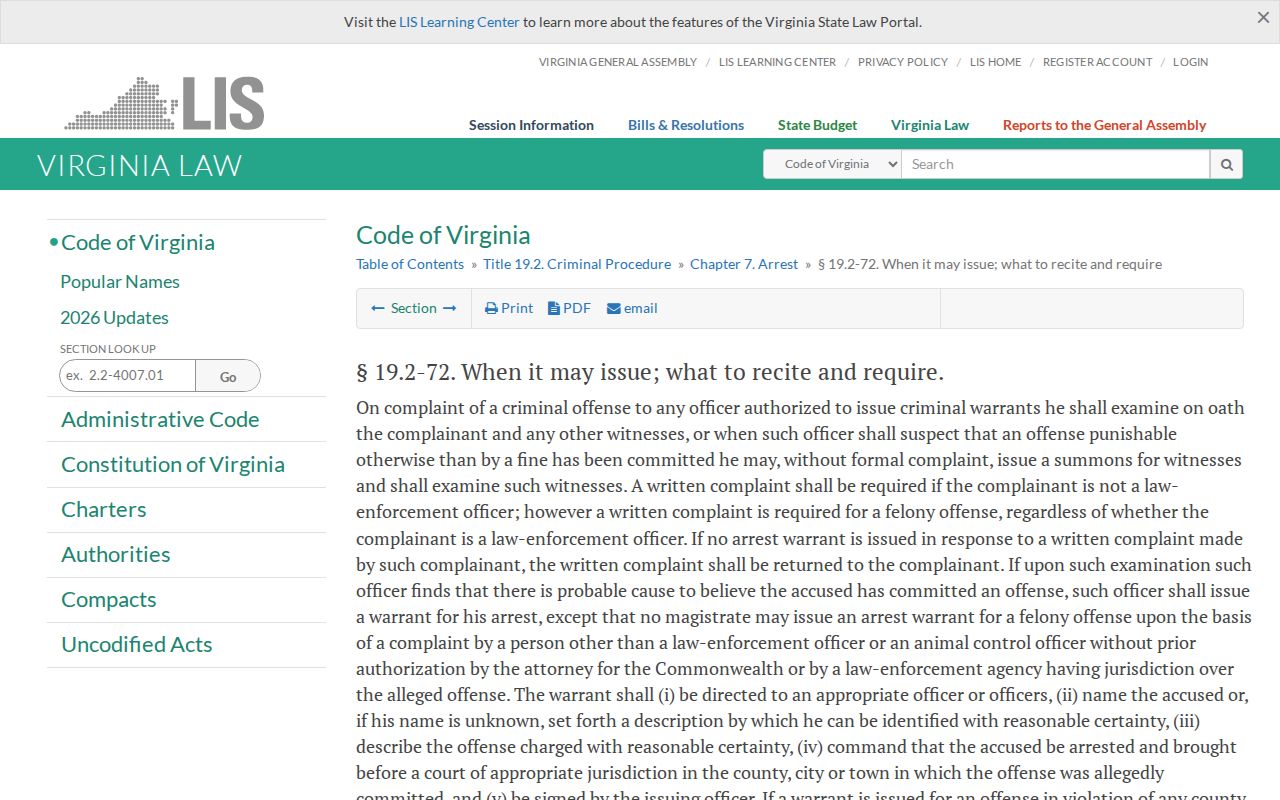
The statute image provides process context; it is not a Surry-specific warrant form.
Arrest Warrants: What They Contain
A public OCIS case view can carry a lot: court, case number, defendant display, charge, code section, offense date, hearing date, and later case events. Virginia's statute fixes what a warrant itself must contain. The public search still may not show every signed page or supporting affidavit. Surry County publishes no distinct warrant-number format. Any sample number here is a fictional OCIS format example. It is not a code for a real Surry charge.
| Case number | CR12345678-90 is an OCIS format example, not a real warrant number. |
|---|---|
| Accused / description | The warrant identifies a person or reasonably describes the accused. |
| Offense | The order states the offense and directs an appearance. |
| Issuing court | Use the court label to reach the correct Surry clerk. |
| Bond | Case-specific; no universal Surry bond schedule was found. |
| Issue and return | Ask the clerk about the order date and any service return. |
Surry County Arrest Warrant Affidavits
A case index and an affidavit are different records in Surry County, and the difference matters. Virginia Code section 19.2-54 deals with search-warrant affidavits and allows temporary sealing in defined circumstances. That rule does not govern every arrest-warrant paper. For a charging document, ask the issuing clerk whether it is filed, public, redacted, or restricted under another order or statute. Sealed indictments differ too. They are not complaint-based warrants, and they are not bench or capias events. An OCIS case line can appear without exposing the probable-cause material behind it. The clerk can name the public record route; counsel handles any legal challenge. Read Virginia Code section 19.2-54 for the affidavit rule.
How Warrants Get Served in Surry County
The Surry County Sheriff's Office handles arrests, civil process, and courthouse security. Virginia law lets process be directed to an appropriate law-enforcement officer. A town officer or another agency may hold authority in a given matter. The county names no standalone town warrant unit, and no office will promise in advance which agency serves a specific paper. An arrest starts the next stage. A magistrate or court then sets the next appearance and any release conditions. Riverside Regional Jail is a regional custody facility used by Surry, but the jail cannot recall the issuing court's order. The county publishes no booking-to-magistration timeline and no warrant-specific bond schedule.
Surry County Arrest Warrant Service
Three offices, three roles. The court issues its process and can change it; the Sheriff's Office answers service questions; the jail answers custody and facility questions. The Sheriff's public page lists 45 School Street and 757-294-5264, with no dedicated warrant line and no walk-in surrender schedule. For Circuit criminal files, the Surry County Circuit Court page is the official starting point. Its clerk sits at 28 Colonial Trail East, and the court posts its criminal sessions. General District and J&DR matters go through Combined Court Services instead. Check the Surry Circuit Court page for the clerk's file route and contact details.
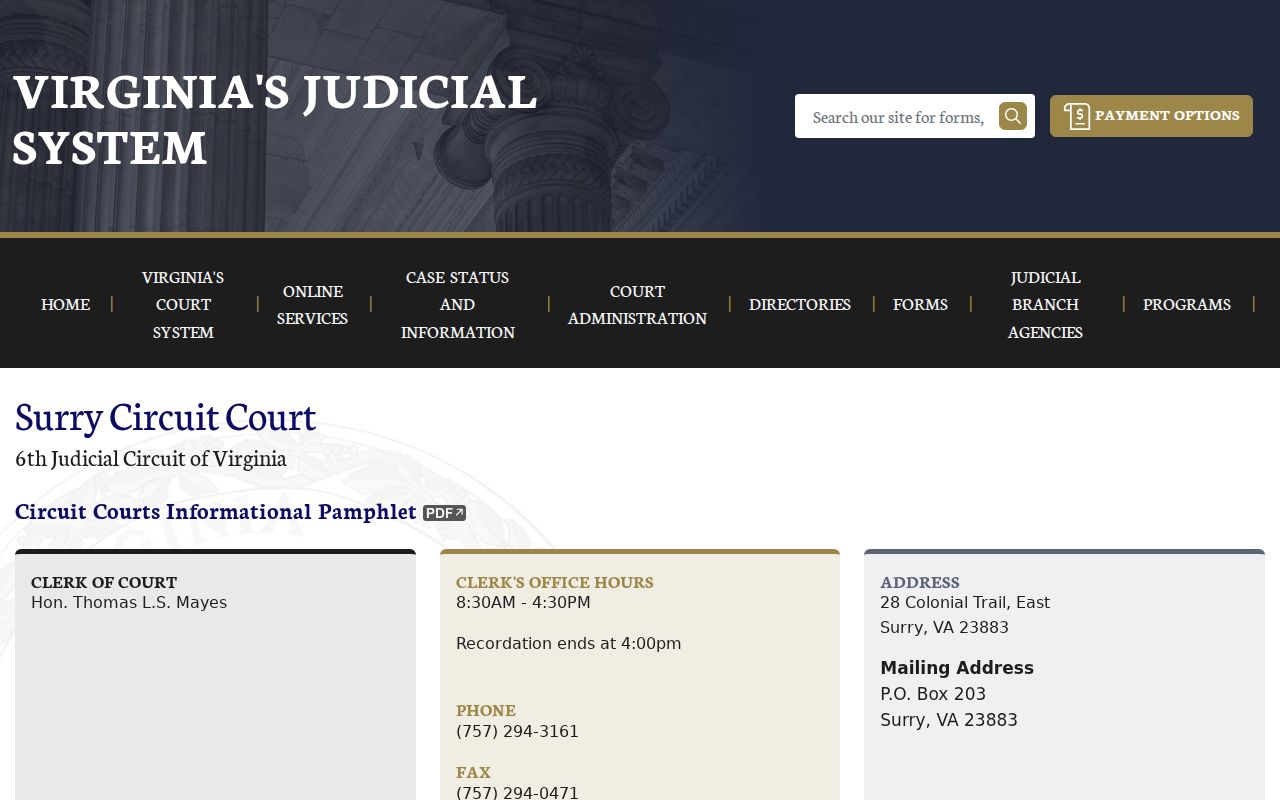
The Surry County court page tells you who holds the file; the Sheriff's Office stays the contact for service.
Arrest Warrants, Summonses, and Bench Warrants
These papers command different things. An arrest warrant orders an arrest on probable cause; a summons directs an appearance; a bench warrant follows a missed court-process event. The signed document, read with the court, sets what a person must do. The Surry County bench-warrant page walks through the missed-appearance route.
| Feature | Arrest Warrant | Summons | Bench Warrant |
|---|---|---|---|
| What it orders | Arrest and appearance before court | Appear as directed | Arrest or appearance after a court event |
| Basis | Probable cause for an offense | Process directing a court date | Missed obligation or court order |
| Issuer | Authorized judge, court, or magistrate | Court or authorized officer | Court handling the case |
| Next step | Contact the issuing court and counsel | Follow the appearance instruction | Ask about recall, new date, or motion |
Surry County First Appearance and Bond
A first appearance in Surry County covers a lot of ground at once: the charge, counsel, release, bond, and the next court date. The judge sets the terms based on the facts, so there is no universal amount or method that fits every case. Release might mean personal recognizance, a secured or unsecured bond, a surety, or continued detention. If the person is already in custody, ask the court or Riverside Regional Jail where a court order or payment must go. The jail's lobby kiosk details cover inmate accounts only. Paying a warrant bond there is not guaranteed. Check the Combined Courts schedule before counting on any listed session, since Surry County court calendars can shift without notice.
When Arrest Papers Name a Federal Court
Sometimes arrest papers point somewhere other than Surry County's General District or Circuit docket. A case filed in the U.S. District Court for the Eastern District of Virginia is federal, and Surry County sits in that court's Richmond Division. That distinction changes where you look. Virginia's OCIS index searches only state courts, so a blank result there says nothing about federal process. Use the EDVA division information to orient yourself, then turn to PACER for electronic access to federal case files. Follow the court and case identifier printed on the official papers. Neither the Surry County Sheriff nor the clerk can alter a federal order.
Handling an Arrest Warrant in Your Name
Finding an arrest warrant in your own name starts with the issuing clerk. Confirm the entry by court and case number, then ask what the court expects: a scheduled appearance, a motion, a bond hearing, or an attorney-arranged visit. Call before you drive anywhere. Surry County's public pages describe no walk-in surrender procedure at the courthouse, the Sheriff's Office, or the jail. From there, a voluntary appearance, a bond posting, or a motion to recall or quash are all possible routes, though only the court controls the order. Keep one thing in mind. A payment or a release does not automatically close the underlying case. The full sequence of Surry County offices is laid out in the Surry County warrant overview.
Important: Speak with a lawyer about a planned appearance; no public source promises that calling or walking in will prevent arrest.