
Claremont Warrant Checks
Claremont has no verified public town warrant portal or separate police warrant desk. Begin by reading the notice for the named court, citation number, or town office. If it is a state court case, Virginia’s OCIS can search by name, case number, or hearing date; if it concerns a town record, ask the Town Hall which office holds it. A search result helps identify a file but does not itself certify whether a warrant is active or recalled.
- Identify the court or record holder printed on the citation, summons, or court paper.
- Search OCIS by name, case number, or hearing date for a state-court case.
- For a Claremont town record, contact Town Hall and ask which custodian handles that record.
- For law-enforcement routing, contact the Surry County Sheriff, which provides Claremont police protection.
- Ask the issuing clerk to confirm any warrant entry and speak with an attorney about the legal response.
Claremont Town Hall Is a Local Records Contact
The Claremont town website identifies Town Hall at 4115 Spring Grove Avenue, P.O. Box 310, Claremont, Virginia 23899, with telephone 757-866-8427. Town Hall is the useful starting point for determining who keeps an ordinance, meeting, or municipal correspondence file. It is not described as a warrant lookup service, and the research found no town-hosted public court calendar or active warrant list.
When contacting the office, name the specific document, date range, and type of record you need. If staff identifies a state court as the source, move the inquiry to that clerk rather than treating a town record request as a court-status check.
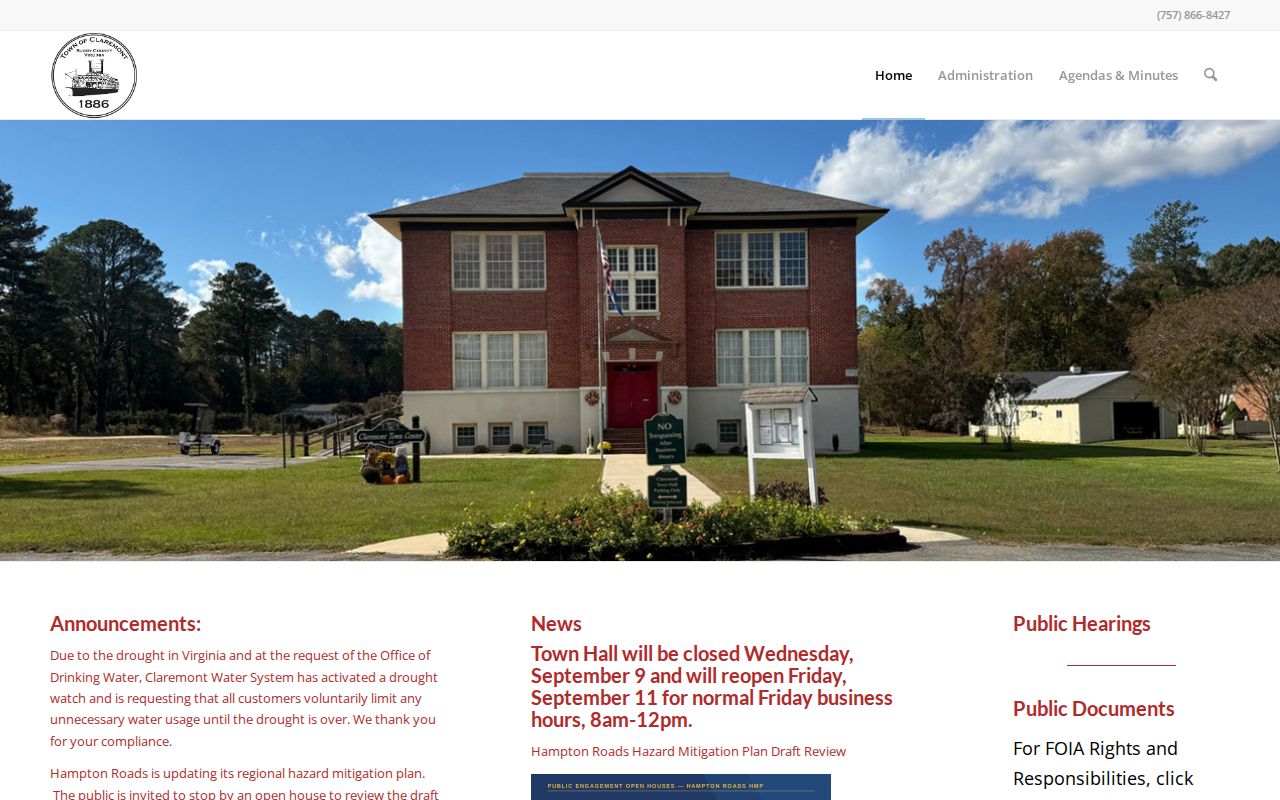
Use the listed office to ask which local department holds a town document. For a court order, the town can help route the inquiry but cannot replace the issuing clerk’s case-status answer.
Policing and Courts in Claremont
Claremont’s official comprehensive plan says the Surry County Sheriff provides police protection. The research does not verify a separate Claremont police department, municipal court clerk, warrant desk, or public warrant portal. That matters when interpreting a town name on a record: the town’s location does not necessarily identify the agency that issued a court order.
For a criminal or traffic case, use the state court named in the papers. Claremont Town Hall can route questions about town government files, while the Sheriff handles law-enforcement contacts. A clerk can confirm docket events and whether an order was recalled; only an attorney can advise what legal step to take.
Claremont’s Sheriff Service and Public Safety
The public-safety section of Claremont’s official plan assigns police protection to the Surry County Sheriff. This gives residents a county agency for local law-enforcement contact, while the town’s own office remains the route for municipal government records. The research does not identify a separate Claremont police warrant counter or a standalone town list.
See the Claremont plan’s public-safety discussion and the Sheriff Department directory for their distinct roles. A service arrangement helps identify who handles a question; it does not establish the outcome of a court case.
Warrants in Claremont: The Main Types
The research confirms a town service arrangement, but not a separate municipal court warrant process. The distinctions below help sort a Claremont address from the authority that actually issued a case order. A traffic citation or court notice should be checked with the named state court; a local ordinance document should be directed to the town custodian until the town identifies another holder.
| Warrant Type | How It Arises | Who Issues It |
|---|---|---|
| Traffic case order | A citation or missed state-court setting | The General District Court named on the case |
| Bench warrant or capias | A court proceeding or missed appearance, depending on the file | The court that entered the order |
| Arrest warrant | A criminal complaint supported through the required process | A magistrate or court, with law-enforcement execution |
| Town ordinance record | A local-code or municipal matter | Ask Claremont which office holds the record; no current separate court was verified |
A Claremont Address Does Not Name the Record Holder
A municipal address may appear on a town record, state-court case, or Sheriff contact, but the place alone does not say which office issued an order. Claremont’s plan is specific about its police-protection arrangement; it does not create a separate court index. Use the court or agency named on the source document before interpreting a search result.
This distinction is especially useful when a public case search returns a similar name. Confirm the charge, date, and court against the original Claremont notice. If the paper is an ordinance or town-government record, ask Town Hall which office keeps it rather than assuming a court file exists.
Claremont Warrant Records: What They Show
Virginia’s public case index can display a court, case number, defendant, offense date, hearing date, charge, and code section. It may also show hearings or dispositions, but it has no separate active-warrant indicator. If a Claremont-related result appears, match it to the original citation or notice and ask the issuing clerk whether the order is current.
| Case number | Use the identifier printed on the citation or court notice; do not substitute a name-only match for a confirmed file. |
|---|---|
| Defendant and charge | Compare the person and alleged offense with the paperwork you hold; similar names can refer to different cases. |
| Court and dates | The court selector, offense date, and hearing date help route a question to the proper clerk. |
| Docket event | A hearing, service, or disposition may appear, but does not necessarily identify warrant status. |
| Current order | OCIS has no dedicated warrant flag. Ask the issuing court whether an order remains active. |
Search by Claremont Address Only After Identifying the Case
A town name or mailing address is not a court identifier. OCIS asks the user to select a court and supports searches by name, case number, or hearing date. Its case results can help locate a public adult case, but they do not return a comprehensive Claremont warrant list. Juvenile case visibility is restricted, and some warrant-related material may be sealed.
Before searching, gather the citation number, the court shown on the document, and the approximate hearing date. If a name search returns multiple people, compare the charge and dates rather than choosing the first matching result.
Claremont Warrants and Surry County
Claremont’s plan places police protection with the Surry County Sheriff. State-court cases remain with the court that filed them, and public OCIS records are only one part of checking status; law-enforcement systems VCIN and NCIC are not public lookup tools.
Warrant flow: Claremont Town Hall for town records › Surry County Sheriff for police contact › named Virginia court for case status
For county-level court contacts and the statewide case-index limits, use Surry County warrant records and the county warrant check. A Claremont address does not create a separate county warrant category.
Claremont Has No Verified Local Warrant Roster
The research found no official town active-warrant page, municipal court docket, warrant-roundup notice, or separate Claremont police roster. That finding describes public sources reviewed; it is not evidence that no warrant exists. A current response must come from the named court or appropriate law-enforcement office.
The Sheriff directory is a route for public contact, while the town website is the route for Claremont government information. Keep those functions separate when asking whether a record exists, requesting a copy, or asking how a court order can be addressed.
Accessing Claremont Warrant Records
The Virginia Freedom of Information Act applies to qualifying government records held by a public body, subject to statutory exemptions and redactions. A request for a town record should go to the town custodian; a court case should be checked through the court’s case channel. FOIA does not turn confidential juvenile files, protected law-enforcement information, or temporarily sealed warrant affidavits into open records.
Claremont Record Access Rules:
Virginia Freedom of Information Act, Va. Code § 2.2-3704 - requests must describe the records sought with reasonable specificity.
Va. Code § 16.1-305 identifies who may inspect juvenile court files and specified related records.
Va. Code § 16.1-301 separately protects juvenile law-enforcement material from public disclosure.
Claremont Requests and Court Confidentiality
For a Claremont-held meeting, ordinance, or correspondence record, contact the town office and ask for its records custodian. Virginia FOIA covers public-body records and allows inspection or copies subject to exemptions. A request should identify the records sought with reasonable specificity and state a preferred format. If Claremont directs you to a county-held record, the county FOIA page explains that separate request route.
Some court material is unavailable even when a related docket can be searched. Juvenile case files have restricted inspection under § 16.1-305, while juvenile law-enforcement records have separate protections under § 16.1-301. A search-warrant affidavit may also be temporarily sealed under § 19.2-54. Ask for nonexempt material and follow the custodian’s redaction explanation.